
Why Every Freelance Creative in India Needs a Portfolio That Works While They Sleep
Most creative talent in India gets work through referrals. Here's why that's a risk — and what a verified portfolio on the right platform actually does for your career.
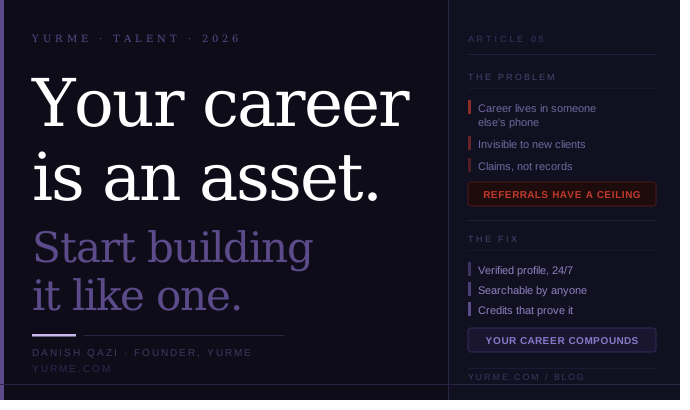
Referrals get you your first ten jobs. A verified portfolio gets you the next hundred.
How most creative talent in India actually gets work
Ask any working actor, model, cinematographer, or editor in India how they got their last booking. The answer is almost always the same.
Someone knew someone. A production manager forwarded their number. A director remembered working with them two years ago. A casting agent had their photo saved from a previous shoot.
The referral network is the backbone of India's creative industry. And for a long time, it works. You do good work, people remember you, more work follows.
But here is what nobody talks about openly: the referral network has a ceiling. And most creative professionals hit it without realising what happened.
The casting director who always called you retires. The production house restructures. The WhatsApp group goes quiet. And suddenly the phone stops ringing.
This is not a failure of talent. It is a failure of infrastructure. The career you built over years — the shoots, the clients, the credits, the relationships — exists almost entirely in other people's memories and contact lists. Not in anything you own or control.
The problem with relying only on referrals
Referrals are powerful. But they have three structural weaknesses that every creative professional should understand.
The first is invisibility. You are only discoverable to people who already know you exist. A brand in Delhi searching for a specific type of model at 11pm on a Sunday cannot find you — even if you are exactly what they need — because you are not in a searchable system. You are in someone's phone.
The second is fragility. Your career depends on a handful of relationships staying active. One person moves cities. One agency closes. One production house changes their regular crew. And a significant part of your work pipeline disappears with them.
The third is unprovability. Anyone can claim they have worked on fifty ad films. Anyone can say they have shot for major brands. In an industry with no verified record system, claims are just claims. The talent who actually did the work has no more credibility than someone who says they did.
Your career history lives in WhatsApp threads and someone else's memory. That is not an asset. That is a dependency.
What a portfolio that works while you sleep actually looks like
It is not an Instagram page. Instagram is a social platform — it is designed for engagement, not for professional discovery. A casting director looking for a specific type of talent does not scroll Instagram hoping to find them.
It is not a PDF sent over WhatsApp. A PDF cannot be searched. It cannot be filtered by role, location, rate, or availability. It exists in one person's downloads folder and nowhere else.
A portfolio that works while you sleep is a structured, searchable professional profile. One that is live at all times, visible to the people who are actively looking for talent like you, and built around how the industry actually searches — not how you want to present yourself.
It has your role type clearly defined. Your physical attributes if relevant. Your location and availability. Your rate. Your actual credits — not a vague list of productions, but verified records that confirm you were there and what you did.
And it exists on a platform where the people hiring are also present. Because a perfect profile on a platform nobody uses is still invisible.
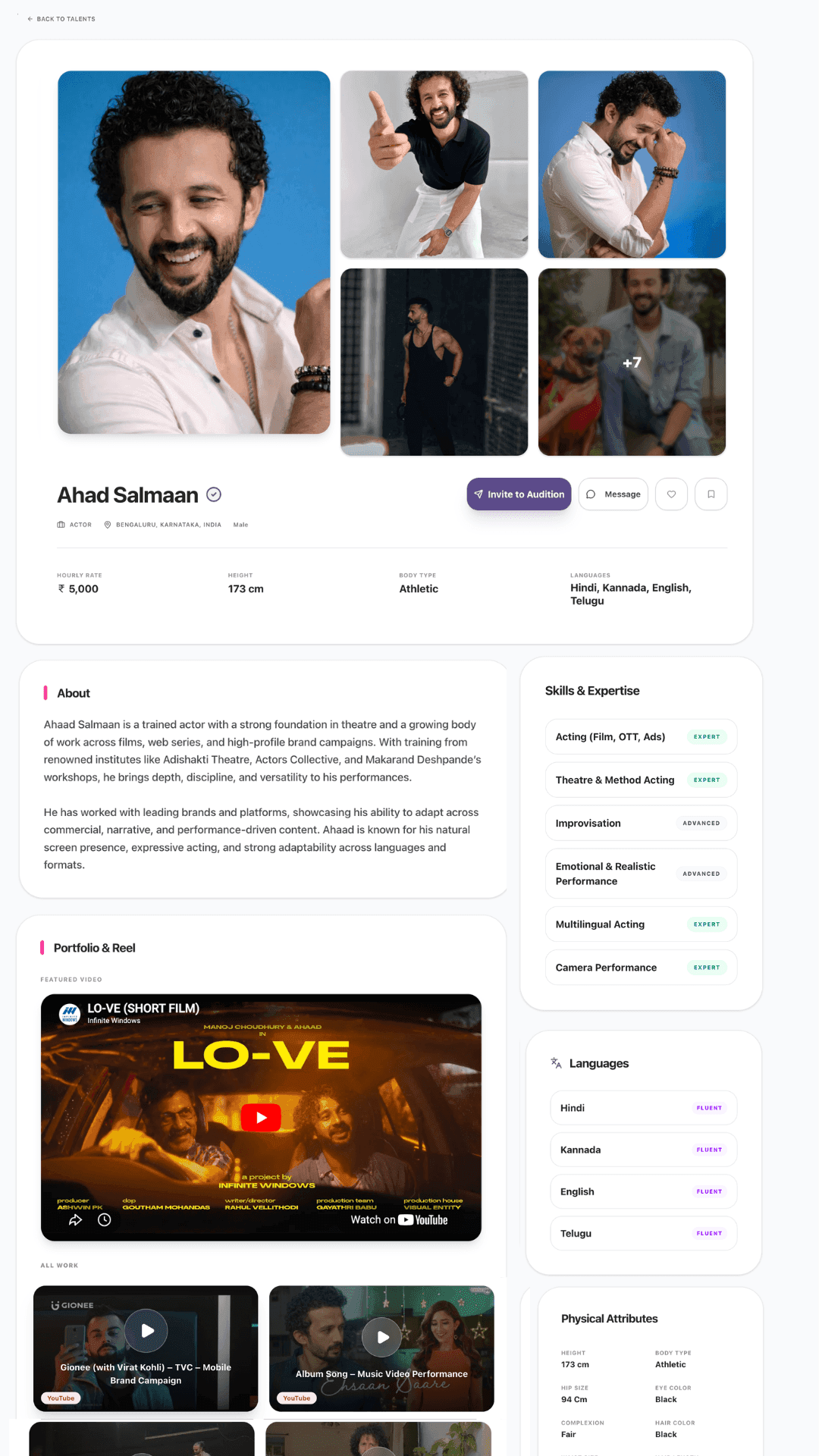
The difference between a profile and a verified credit
This is one of the most important distinctions in building a credible creative career — and almost nobody talks about it.
A profile is what you say about yourself. It can be anything. There is no check, no verification, no way for a casting director or production manager to know if what you claim is true.
A verified credit is different. It is a record generated when a booking is completed and confirmed by both sides through a platform. The production house confirms you were on the project. The record is permanent. It cannot be edited or deleted. It is fraud-proof.
Anyone can write "worked on 50 ad films" in a bio. A verified credit means the production confirmed it. That is the difference between a claim and a record.
In an industry that runs largely on trust and personal relationships, a verified credit is the closest thing to an objective proof of your career. It removes the need to take your word for it. It makes your profile credible to someone who has never heard of you.
This is what Yurme Credits does. Every booking completed through Yurme generates an automatic, verified credit — tied to the project, the client, and the role. Over time, your profile becomes a career record that speaks for itself.
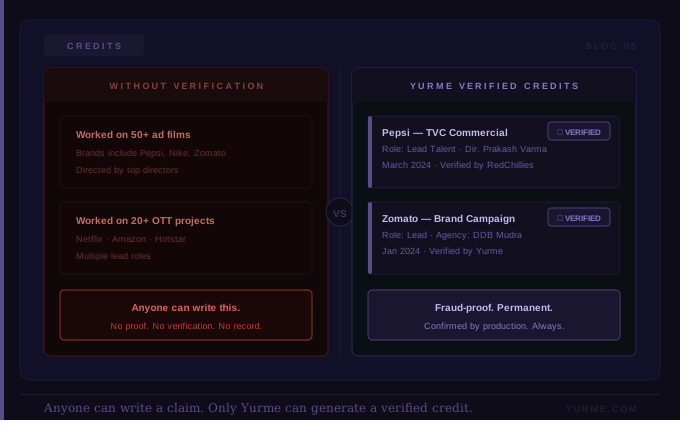
What casting directors and production teams actually search for
Most talent builds their profile around what they want to show. The shift that changes everything is building it around what the person hiring you is actually searching for.
Here is how a casting director or production manager typically searches for talent. They have a brief. It specifies a role type — model, actor, background artist, cinematographer, editor. It may specify a location, because shoot logistics matter. For on-screen talent, it often specifies physical attributes. It almost always has a budget, which means a rate range. And for more senior roles, it involves looking at past work — specifically, work on projects or brands the hiring team recognises.
Now look at your profile through that lens. Does your role type match exactly how they would search? Is your location current? Have you set a real rate? Do your credits include recognisable work? Is your availability updated?
Every gap in your profile is a reason for the search to skip past you. Every complete, accurate field is a reason to stop and look.
How to build a profile that gets you booked
Five things. In order of impact.
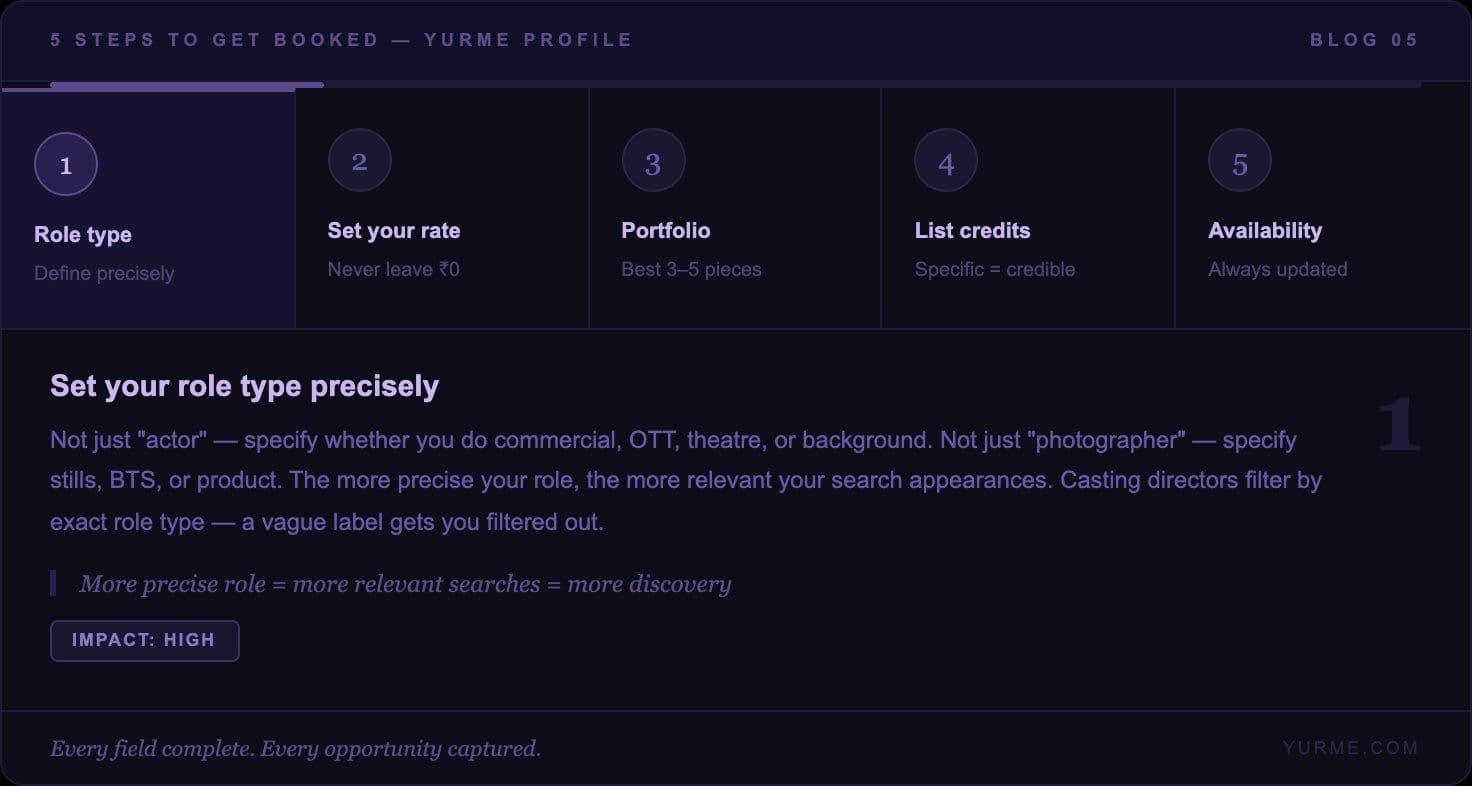
- Set your role type precisely. Not just "actor" — specify whether you do commercial, OTT, theatre, background. Not just "photographer" — specify stills, BTS, product. The more precise your role, the more relevant your search appearances.
- Set a real rate. A profile showing ₹0/hr tells the casting director nothing and signals an incomplete profile. If you are unsure of your rate, use the Yurme rate card as a reference. Even an approximate range is better than nothing.
- Upload portfolio work. Three to five strong pieces that show your best work in your primary role. Not everything you have ever done — your best, most relevant work for the roles you want.
- List your actual credits. Every project you have completed that you can verify. Productions, brands, directors, platforms. The more specific, the more credible.
- Keep your availability updated. A casting director who finds your profile and cannot tell if you are available will move to the next person. Availability is the last gate between discovery and booking.
Your career is an asset. Start building it like one.
Every shoot you do is a data point. Every client you work with is a relationship. Every credit you earn is proof of something real.
Right now, for most creative professionals in India, all of that lives scattered across WhatsApp messages, memory cards, hard drives, and other people's contact lists. It is invisible to anyone who does not already know you. It is fragile. And it is not working for you when you are not actively in a room with someone.
Building a professional profile is not vanity. It is infrastructure. It is the difference between a career that depends entirely on who you know and a career that compounds — where every piece of work you do makes the next opportunity more likely, regardless of whether the person who hires you has ever heard of you before.
The best time to start building it was when you did your first booking. The second best time is now.
Create your free Yurme profile → [ Join as Talent ]